
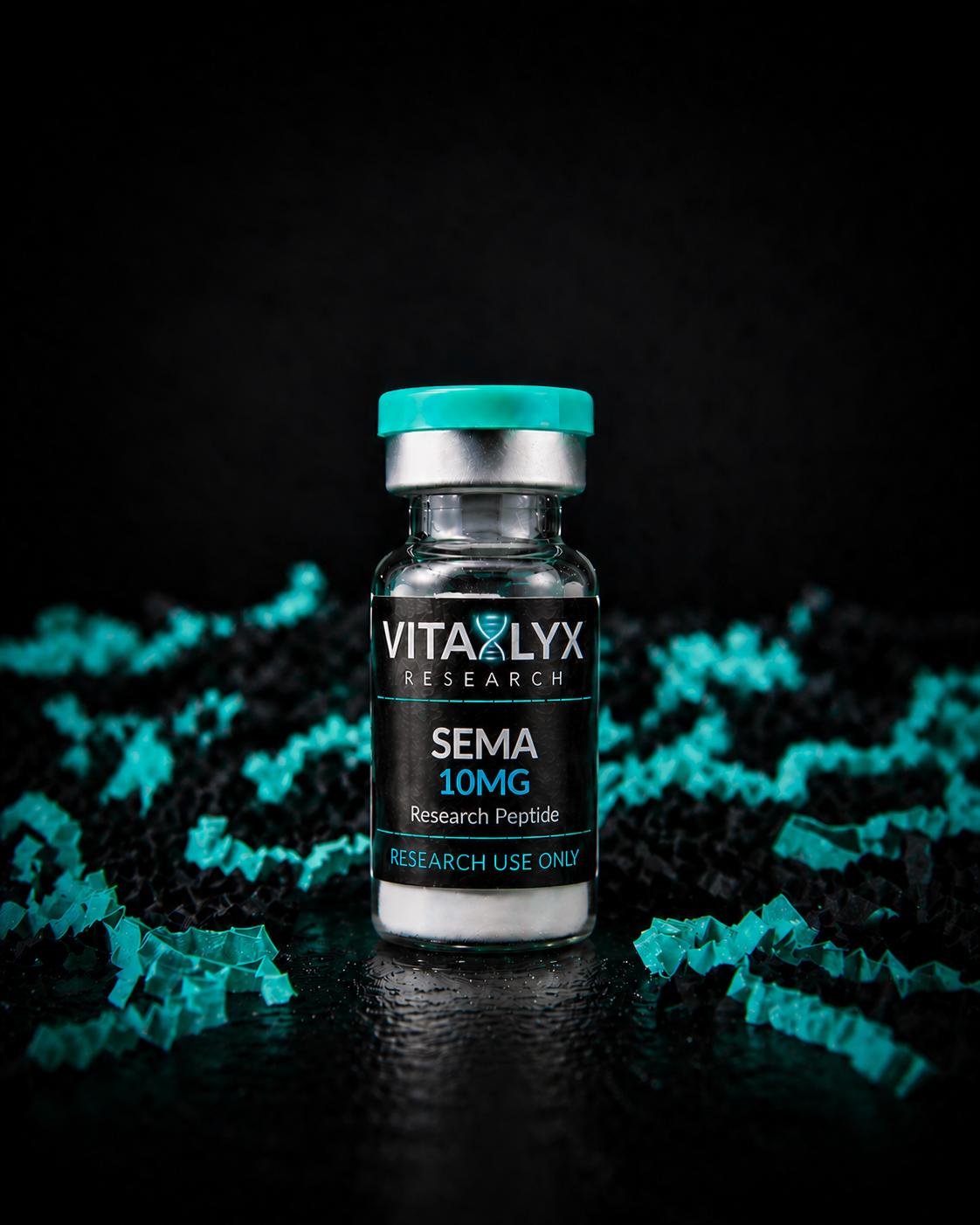
REGULATORY STATUS : READ BEFORE PROCEEDING Semaglutide is an FDA-approved prescription drug (NDA 209637, NDA 213051, NDA 215256) marketed as Ozempic, Rybelsus, and Wegovy by Novo Nordisk. It is NOT a research-use-only (RUO) compound. This document is a scientific reference resource providing registry-anchored pharmacological and regulatory information for educational, academic, and pharmaceutical research professional use only. This document does not constitute a product listing, does not represent an offer to supply semaglutide, and must not be construed as guidance for therapeutic, compounding, or clinical use. FDA declared the semaglutide shortage resolved on 21 February 2025 and has since intensified enforcement against compounders, telehealth platforms, and marketers of unapproved semaglutide products. Compounded or “research” semaglutide products are treated as high-risk and non-substitutes for approved medicines under 2025-2026 FDA policy. Consult a licensed healthcare provider and FDA.gov for approved use information.
PRODUCT OVERVIEW
Semaglutide is a long-acting, chemically modified glucagon-like peptide-1 (GLP-1) receptor agonist, classified as a GLP-1 receptor peptidomimetic agonist derived from human GLP-1 (7–37). Its peptide backbone, produced by yeast (Saccharomyces cerevisiae) fermentation and subsequently chemically modified, is 94% homologous to native human GLP-1.
Three deliberate medicinal-chemistry edits define semaglutide’s pharmacological character: α-aminobutyric acid (Aib) substitution at position 8 confers resistance to dipeptidyl peptidase-4 (DPP-4) enzymatic cleavage at the Ala8-Glu9 scissile bond; arginine substitution at position 34 replaces Lys34 to prevent unwanted off-site acylation and ensure single-site conjugation chemistry at Lys26; and Lys26 acylation via a hydrophilic spacer to a C18 stearic diacid fatty chain promotes strong, reversible, non-covalent albumin binding (greater than 99% bound in circulation), dramatically reducing renal filtration rate and proteolytic access to extend plasma half-life from approximately 2 minutes (native GLP-1) to approximately one week, enabling once-weekly subcutaneous dosing and — when co-formulated with the absorption enhancer SNAC (sodium N-[8-(2-hydroxybenzoyl)amino]caprylate) — once-daily oral administration.
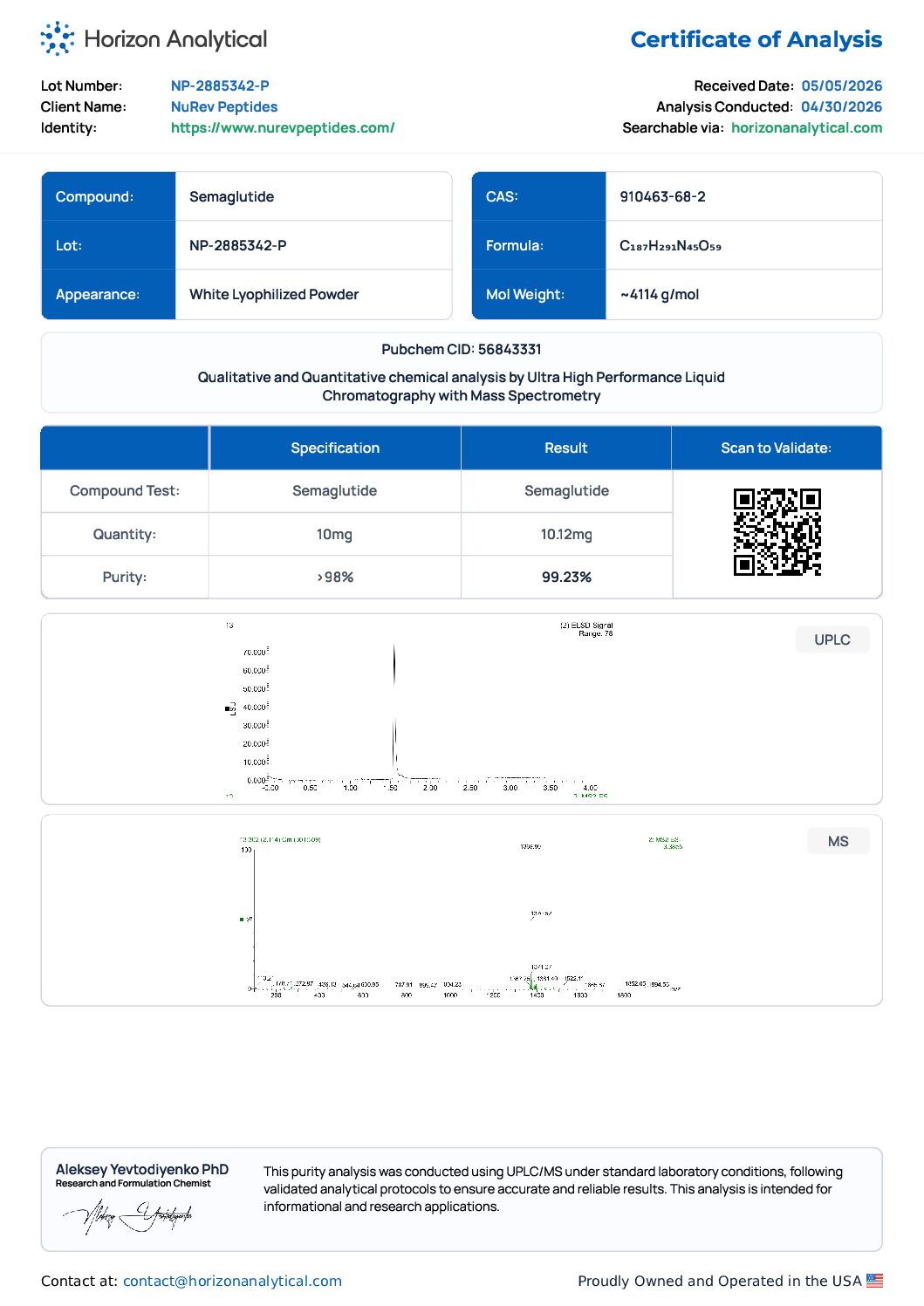
Its approved molecular formula is C187H291N45O59, molecular weight 4113.58 g/mol, registry-anchored at PubChem Compound ID (CID) 56843331 with cross-referenced substance records SID 135267256 (Semaglutide [USAN:INN], ChemIDplus), SID 354702201 (IUPHAR/BPS Guide to Pharmacology, Ligand ID 9724), and SID 341186755 (Springer Nature). Within the pharmacological class of GLP-1 receptor agonists — alongside exenatide, liraglutide, dulaglutide, tirzepatide, and newer agents — semaglutide’s extended acyl chain and specific backbone substitutions confer unusually high receptor potency and prolonged circulating exposure, distinguishing it within this class and contributing to the breadth of its clinical evidence base across glycemic, cardiovascular, renal, hepatic, and body-composition endpoints.
Semaglutide is an FDA-approved prescription drug commercialised in multiple presentations: Ozempic (NDA 209637, subcutaneous and tablet), Rybelsus (NDA 213051, oral tablet), Wegovy (NDA 215256, subcutaneous and tablet, including Wegovy HD 7.2 mg approved March 2026). It is no longer a single-product opportunity but a platform franchise spanning metabolic, cardiovascular, renal, and liver indications. The IUPHAR/BPS Guide to Pharmacology and KEGG classify semaglutide within antidiabetic and anti-obesity drug pathways, mapping its actions onto incretin and energy-homeostasis modules. These cross-references reinforce that semaglutide is a well-characterised pharmaceutical agent rather than a generic “research peptide.”
This document is a scientific reference resource for pharmaceutical research professionals, academic investigators, regulatory affairs specialists, and compliant content creators seeking registry-anchored molecular, pharmacological, and regulatory information about semaglutide in the context of the 2026 U.S. GLP-1 researc
Reviews
There are no reviews yet.